The material here gathered, is part of a larger work process. Seeing that the Moon is in Cancer, it would be suitable to contemplate this particular Lunar energy through various cross-cultural examples. Firstly, we have an initiatory experience from an Isis devotee of the Roman world; followed by a vision of an English Alchemist; then a text on the Tibetan Green Tara, and some examples of Marian visions of Fatima, which I think can be compared to the luminosity in our examples, and finally, as a comparison to the Robert Graves translation, the version of the great 17th century Jesuit Scholar, Athanasius Kircher.
Peace - Samten

In The Golden Ass of Apuleius, which was written by a Roman citizen of Madaura, North Africa, in the 2nd century C.E. Lucius is transformed into an ass through meddling with an unsavoury magical practices, and undergoes many trials and tribulations in jackass form, until he is transformed back into human form, at the end of the novel, and experiences this vision of the Goddess Isis:
This is the Robert Graves translation:
“I had scarcely closed my eyes before the apparition of a woman began to rise from the middle of the sea with do lovely a face that the gods themselves would have fallen down in adoration of it. First the head, then the whole shining body gradually emerged and stood before me poised on the surface of the waves. Yes, I will try to describe this transcendent vision, for though human speech is poor and limited, the Goddess herself will perhaps inspire me with poetic imagery sufficient to convey some slight inkling of what I saw.
Her long thick hair fell in tapering ringlets on her lovely neck, and was crowned with an intricate chaplet in which was woven every kind of flower. Just above her brow shone a round disc, like a mirror, or like the bright face of the moon, which told me who she was. Vipers rising from the left-hand and right-hand partings of her hair supported this disc, with ears of corn bristling beside them. Her many-coloured robe was of finest linen; part was glistening white, part crocus-yellow, part glowing red and along the entire hem a woven bordure of flowers and fruit clung swaying in the breeze. But what caught and held my eye more than anything else was the deep black lustre of her mantle. She wore it slung across her body from the right hip to the left shoulder, where it was caught in a knot resembling the boss of a shield; but part of it hung in innumerable folds, the tasselled fringe quivering. It was embroidered with glittering stars on the hem and everywhere else, and in the middle beamed a full and fiery moon.”
THE GODDESS TARA IN A 17TH CENTURY VISION
"I could see between me and the light a most exquisite, divine beauty - her frame neither long nor short but of middle, decent stature. Attired she was in thin loose silk but so green that I never saw the like, for the colour was not earthly. In some places in was fancied with white and silver ribbons, which looked like lilies in a field of grass. Her head was overcast with a thin, floating tiffany, which she held up with one of her hands and looked as it were from under it. Her eyes were quick, fresh and celestial but had something of a start, as if she had been puzzled with a sudden occurrence. From her black veil did her locks break out, like sunbeams from a mist. They ran dishevelled to her breasts and then returned to her cheeks in curls and rings of gold. Her hair behind her was rolled to a curious glove, with a small short spire, flowered with purple and sky-coloured knots. Her rings were pure, entire emeralds - for she valued no metal - and her pendants of burning carbuncles. To be short, her whole habit was youthful and flowery: it smelled like the East and was thoroughly aired with rich Arabian diapasons. "
Vaughan, Thomas. Lumen de Lumine: Or A new Magicall Light discovered, and Communicated to the World By Eugenius Philalethes... London, Printed for H. Blunden at the Castle in Corne-Hil. 1651.
The Blessed Lady, the Holy Tara
Then he should meditate on the Blessed Lady, the Green Tara, as proceeding from the yellow germ-syllable TAM, which stands on the spotless orb of the moon, which again is inside the filament. of the full blown lotus, which is within the lunar orb originally established on the heart. He should conceive her to be of deep green colour, two-armed, with a smiling face, proficient in every virtue, without defect of any kind, adorned with ornaments of heavenly gold, rubies, pearls and jewels; her twin breasts decorated with lovely garlands, her two arms decked with heavenly bracelets and bangles, her loins beautified with glittering rows of girdles of flawless gems, her two ankles beautified by golden anklets set with divers gems, her hair entwined with fragrant wreaths made of the flowers of the paradise tree and others of that kind, with the figure of the Lord Amoghasiddhi, the Tathagata, in her resplendent jewelled headdress, - a radiant and most seductive similitude, in the prime of her youth, with eyes of the blue of the autumn lotus, her body robed in heavenly garments, in the Arddhaparyanka posture, within a circle of white rays on a white lotus as large as a cart wheal, her right hand in the sign of generosity (varada) and holding in her left a full blown blue lotus. Let him develop this likeness of our Blessed Lady as long as he wishes.
Thereupon our eternally perfect Blessed Lady is led forth out of space, in her intelligible aspect, by means of the numerous sheaf’s of rays which illumine the triple world, and which issue from the yellow germ-syllable TAM, which is in the filaments of the lotus in the moon of which the orb was established on the heart, and from that Blessed Lady (herself). When he has led her forth and established her on the background of the firmament, he should offer an oblation at the feet of that blessed Lady, with scented water and fragrant flowers in a jewelled vessel, and should offer a respectful welcome (lit. worship) to her in many ways, with heavenly flowers incense, scents, garlands, unguents, aromatic ponders, garments, umbrellas, flags, bells, banners, and so forth. After he has thus again and again worshipped, and lauded her, he should exhibit the appropriate finger-sign called 'the open lotus flower'. After he has, with this mudra gratified our Blessed Lady's intelligible aspect, he should develop the incantation ( mantra) in relation to her contingent aspect. And he should resolutely believe in the non-duality of these two aspects.
Thereupon the rays which issue from the germ-syllable TAM that is upon the spotless orb of the moon within the filaments of the blue lotus in the lunar orb, - rays that are of unlimited range, proper to the divine Tara, and that illuminate the ten quarters of the triple world, - now take away the poverty and other ills of beings who live in this triple world, by means of showers of manifold jewels which rain down from above, and they refresh them with the nectar of the teachings of the Dharma, which reveals all things as impermanent, without self, and so forth. After he has thus concerned himself with the divers needs of the world, he should evolve also in his meditation the cosmic aspect of Tara. Again he should meditate, until tired, on whatever has come to be in the yellow germ-syllable TAM, in the stages of expansion and contraction. If he gets exhausted from his meditation, he should murmur the mantra which is here OM TARE TUTTARE TURE SWAHA, This truly royal mantra is of great power. All Tathagatas have honoured, worshipped and revered it.
When he has emerged from the trance, the Yogin, who has seen the whole universe in the form of Tara, should dwell at will conscious of his own identity with the Blessed Lady.
JETSUN DOLA (ARYA TARA) in her green form, symbolising the Perfection of Wisdom. "She is the remover of hindrances and obstacles." The Mother of Compassion in Bodhisattva form, has the seed syllable TAM (in green), standing on a moon mat in a lotus. Her root mantra is
OM TARE TUTTH TARE TURE SWAHA.
THE HOLY MOTHER AT FATIMA & OTHER VISIONS:
"Rogo said, "... The sun dimmed, and a kaleidoscope of colours bathed the Cova. ..." ... Around noon they saw the sun become dim and they could see the stars in the sky. They also so a globe of white light settle on the tree ... . ... the vice-general of the town of Leiria, said, "... I saw clearly and distinctly a globe of light advancing from east to west, gliding slowly and majestically through the air. ...". On this occasion there was also a rain of white flower petals, which mysteriously disappeared before they reached the ground." [falling through the air of spectral flower-petals is an commonplace of Buddha lore] ...
"People who looked ... saw a glowing slivery disk. Some researchers believe this was a UFO. Others believe the movements were those of the sun itself. {when I have seen (on several occasions) the sun move around erratically in the sky, it was always coloured (yellow or blue); when the sun did not move except to set at its usual rate it was uncoloured (black); when there was something silvery in the sky (on various occasions) I deemed it a flying saucer} The glowing disk revolved on its axis, sending rainbow-coloured beams of light in all directions. This continued for twelve minutes. Then the disk, moving in zigzag fashion, plunged earthward. ... Suddenly the disk rose back into the sky. ...
"I ... saw it looking like a well-defined disc, bright but not blinding. ... This chequered shining disc seemed to possess a giddy motion. ... It turned on itself with an astonishing rapidity. ... The sun while keeping its swiftness of rotation, detached itself from the firmament and, blood-red in colour, rushed towards the earth ... .
"... I looked fixedly at the sun, which appeared pale and did not dazzle. It looked like a ball of snow turning on itself. ... Then suddenly it seemed to become detached from the sky, and rolled right and left, as if it were falling upon the earth. ... During the long minutes of the solar phenomena, the objects around us reflected all the colours of the rainbow. Looking at each other, one appeared blue, another yellow, a third red, etc. [these colours which the people became may have been manifestations of their auras, or rather, perispirits ] ..."
From D. Scott Rogo: Miracles : a Parascientific Study. New York, Dial Press, 1982, pp. 376-377
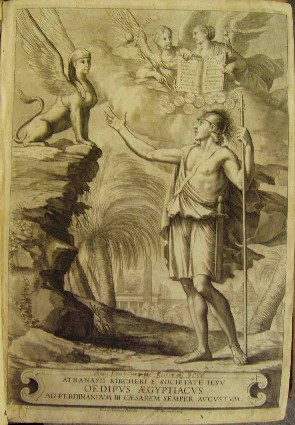
The Goddess: Isis and her various other names and symbols: from Athanasius Kircher: From Oedipus Aegyptiacus (1652-4) Based on Apuleius, The Golden Ass, Book 11, chapter 47:
Then by little and little I seemed to see the whole figure of her body, mounting out of the sea and standing before me, wherefore I purpose to describe her divine semblance, if the poverty of my human speech will suffer me, or her divine power give me eloquence thereto. First she had a great abundance of hair, dispersed and scattered about her neck, on the crown of her head she bare many garlands enterlaced with flowers, in the middle of her forehead was a compass in fashion of a glass, or resembling the light of the Moon, in one of her hands she bare serpents, in the other, blades of corn, her vestment was of fine silk yielding divers colours, sometime yellow, sometime rosy, sometime flamey, and sometime (which troubled my spirit sore) dark and obscure, covered with a black robe in manner of a shield, and pleated in most subtile fashion at the skirts of her garments, the welts appeared comely, whereas here and there the stares glimpsed, and in the middle of them was placed the Moon, which shone like a flame of fire, round about the robe was a coronet or garland made with flowers and fruits. In her right hand she had a timbrel of brass, which gave a pleasant sound, in her left hand she bare a cup of gold, out of the mouth whereof the serpent Aspis lifted up his head, with a swelling throat, her odoriferous feet were covered with shoes interlaced and wrought with victorious palm. Thus the divine shape breathing out the pleasant spice of fertile Arabia, disdained not with her divine voyce to utter these words unto me: Behold Lucius I am come, thy weeping and prayers hath moved me to succour thee.
"I am she that is the natural mother of all things, mistress and governess of all the elements, the initial progeny of worlds, chief of powers divine, Queen of Heaven, the principal of the Gods celestial, the light of the goddesses: at my will the planets of the air, the wholesome winds of the seas, and the silences of Hell be disposed; my name, my divinity is adored throughout all the world in divers manners, in variable customs and in many names, for the Phrygians call me the mother of the Gods: the Athenians, Minerva: the Cyprians, Venus: the Candians, Diana: the Sicilians Proserpina: the Eleusians, Ceres: some Juno, other Bellona, other Hecate: and principally the Ethiopians which dwell in the Orient, and the Egyptians which are excellent in all kind of ancient doctrine, and by their proper ceremonies accustom to worship mee, do call me Queen Isis.